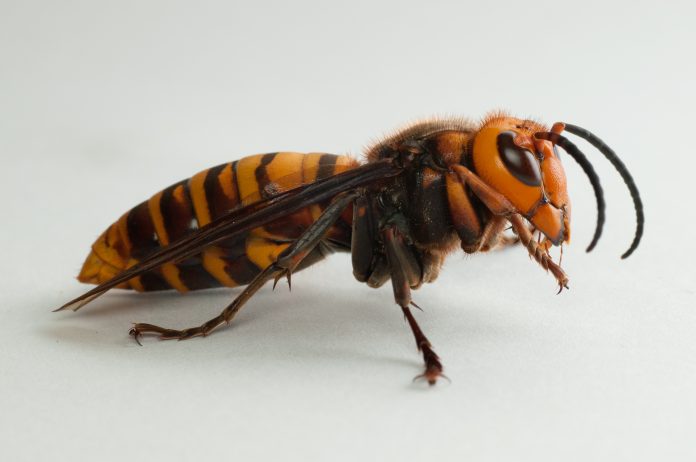
Vespa mandarinia magnifica. control
May. 4th, 2020 06:20 am![[personal profile]](https://www.dreamwidth.org/img/silk/identity/user.png) charisstoma
charisstoma
Vespa mandarinia magnifica. control
https://en.wikipedia.org/wiki/Asian_giant_hornet#Extermination_methods
Extermination methods
As of 1973, six different methods were used to control hornets in Japan. Though these methods decrease damage done by V. mandarinia, controlling them entirely is difficult.
Beating
Hornets are crushed with wooden sticks with flat heads. Hornets do not counterattack when they are in the bee-hunting phase or the hive-attack phase ("slaughter"), but they aggressively guard a beehive once they kill the defenders and occupy it. The biggest expenditure in this method is time, as the process is inefficient.[14]
Nest removal
Applying poisons or fires at night is an effective way of exterminating a colony. The most difficult part about this tactic is finding the subterranean nests. The most common method of discovering nests is giving a piece of frog or fish meat attached to a cotton ball to a wasp and following it back to its nest. With V. mandarinia, this is particularly difficult considering its common home flight radius of 1–2 km. V. mandarinia travels up to 8 km away from the nest.[14]
Bait traps
Bait traps are placed in apiaries. The system consists of multiple compartments that direct the hornet into a one-sided hole which is difficult to return through once it is in the cul-de-sac compartment, an area located at the top of the box which bees can escape from through a mesh opening, but wasps cannot due to their large size. Baits used to attract the hornets include a diluted millet jelly solution, crude sugar solution with a mixture of intoxicants, vinegar, or fruit essence.[14]
Mass poisoning
Hornets at the apiary are captured and fed a sugar solution or bee that has been poisoned with malathion. The toxin is expected to spread through trophallaxis. This method is good in principle, but has not been tested extensively.[14]
Trapping at hive entrances
The trap is attached to the front of beehives. The effectiveness of the trap is determined by its ability to capture hornets while allowing bees to escape easily. The hornet enters the trap and catches a bee. When it tries to fly back through the entrance of the hive, it hits the front of the trap. The hornet flies upwards to escape and enters the capture chamber, where the hornets are left to die. Some hornets find a way to escape the trap through the front, so these traps can be very inefficient. [14]
Protective screens
As explained in the trapping section, if met by resistance, hornets lose the urge to attack and instead retreat. Different measures of resistance include weeds, wire, or fishing nets or limiting the passage size so only bees can make it through. Experienced hornets catch on and eventually stay on these traps, awaiting the arrival of bees. The best method of controlling hornets is to combine these protective screens with traps.[14]
Use as a nutritional supplement
Vespa amino acid mixture is a nutritional supplement consisting of larval saliva sold with the intent of improving endurance during exercise. Several companies in Asia and Europe have begun to manufacture dietary supplements and energy drinks which contain synthetic versions of secretions of the larvae of V. mandarinia, which the adult hornets usually consume. The manufacturers of these products make claims that consuming the larval hornet secretions (marketed as "hornet juice") will enhance human endurance because of the effect it has on adult hornets' performance. During laboratory testing on mice, increased lipolysis (metabolism of fat) was observed in rat adipocytes (fat cells) alongside improved swimming endurance, decreased lactate, and increased glucose concentration in the blood stream. While testing on mice has produced optimistic outcomes, trial tests on humans were inconclusive. Ten trained cyclists were given either an 80 ml serving of the mixture or a sports-drink placebo. Variables tested included the time to complete the 20 km race, peak power, average power, maximum heart rate, and average heart rate. Participants who consumed it had significantly lower maximum heart rates, but no other statistically significant changes were seen.[14]