Ravioli Dough
Jan. 10th, 2018 11:09 pm![[personal profile]](https://www.dreamwidth.org/img/silk/identity/user.png) charisstoma
charisstomawww.williams-sonoma.com/recipe/rav-dough.html
This is the recipe used by Chef Thomas McNaughton of San Francisco restaurant 'Flour + Water' whenever he makes ravioli or a variety of other stuffed pastas, such as his Pumpkin Tortellini with Sage and Pumpkin Seeds. McNaughton emphasizes that pasta is easy to under knead but virtually impossible to over knead (unlike bread, where each type has its sweet spot or ideal kneading time). That said, even though the dough cannot be over kneaded, it can spend too much time on the worktable and, as a direct result, start to dehydrate and be more difficult to form into its final shape. For best results, he recommends kneading the dough for 10 to 15 minutes.
Prep Time: 20 minutes Makes about 20 oz. (625 g) of dough.
Ingredients:
2 well-packed cups (12 1/2 oz./360 g) 00 flour
1 tsp. (1/5 oz./5 g) kosher salt
1/2 cup (3 1/2 oz./100 g) whole eggs (about 2 large eggs)
1/3 cup (3 oz./90 g) egg yolks (5 to 6 yolks)
1 1/2 tsp. (1/4 oz./6 g) extra-virgin olive oil
Directions:
1. Place the flour on a dry, clean work surface, forming a mound about 8 to 10 inches (20 to 25 cm) in diameter at its base. Sprinkle the salt in the middle of the mound. Using the bottom of a measuring cup, create a well 4 to 5 inches (10 to 13 cm) wide, with at least 1/2 inch (12 mm) of flour on the bottom of the well.
2. Slowly and carefully add the whole eggs, egg yolks and olive oil to the well, treating the flour as a bowl. Using a fork, gently beat the eggs without touching the flour walls or scraping through the bottom to the work surface.
3. Then, still stirring, slowly begin to incorporate the flour “walls” into the egg mixture, gradually working your way toward the outer edges of the flour, but disturbing the base as little as possible. If the eggs breach the sides too soon, quickly scoop them back in and reform the wall. Once the dough starts to take on a thickened, paste-like quality (slurry), slowly incorporate the flour on the bottom into the mixture.
4. When the slurry starts to move as a solid mass, remove as much as possible from the fork. Slide a pastry scraper or spatula under the mass of dough and flip it and turn it onto itself to clear any wet dough from the work surface. At this point, with your hands, start folding and forming the dough into a single mass. The goal is to incorporate all the flour into the mass, and using a spray bottle to liberally spritz the dough with water is essential. It is a very dry dough, and it is very important to generously and constantly spritz it with water to help “glue” any loose flour to the dry dough ball.
5. When the dough forms a stiff, solid mass, scrape away any dried clumps of flour from the work surface, which, if incorporated in the dough, will create dry spots in the final product.
6. To knead the dough, on your work surface, drive the heel of your dominant hand into the dough. Push down and release, and then use your other hand to pick up and rotate the dough on itself 45 degrees. Drive the heel of your hand back in the dough, rotate and repeat for 10 to 15 minutes. When the dough is ready, it will stop changing appearance and texture. The dough will be firm but bouncy to the touch and have a smooth, silky surface, almost like Play-Doh. Tightly wrap the dough in plastic wrap before proceeding as directed with your recipe.
Making the Ravioli
https://www.williams-sonoma.com/recipe/tip/making-ravioli.html
Undoubtedly the most well-known filled pasta in Italy, ravioli can be found in different shapes with fillings of various flavors. Following are basic instructions for making ravioli. After cutting the ravioli, crimp the edges with the tines of a fork to add a decorative touch.
1. Place a 12-by-4 1/2-inch sheet of pasta on a lightly floured surface with the longest edge facing you. Fold the dough in half lengthwise, press gently to make a crease and then unfold the dough.
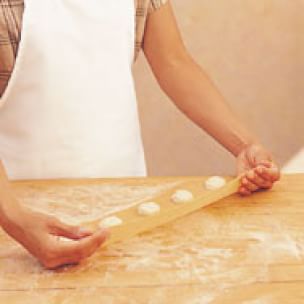
2. Place a scant 1 Tbs. of filling (about 2 tsp.) every
2 1/2 inches along the furthest edge of the pasta, about 1 1/2 inches in from the edge. Dip a finger in a small bowl of water and drag your finger around each mound of filling to moisten the pasta.
3. Fold the front edge of the dough over the mounds. Starting in the center, gently press and shape the dough around each mound, working out to the sides. To ensure that the pasta cooks evenly, make sure the air is pressed out and the filling is secured neatly in a circular mound in the pasta.
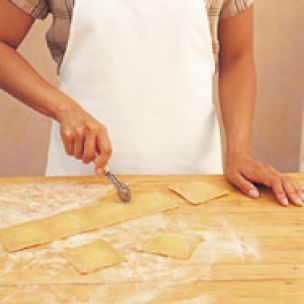
4. Use a sharp knife to cut the ravioli into 2-inch squares, or use a 2-inch round pastry cutter to cut the ravioli into circles. If desired, crimp the edges with the tines of a fork. Transfer the ravioli to a lightly floured sheet pan. Repeat with the remaining dough to make about 40 ravioli.
5. Refrigerate the ravioli for at least 2 hours before cooking. The ravioli can be wrapped tightly and refrigerated for 2 to 3 days or frozen for 4 to 6 weeks.
To cook,
1. Bring a large pot two-thirds full of water to a boil over high heat. Add 1 Tbs. salt and half of the ravioli and return to a boil, stirring gently.
2. Cook until the ravioli float and are al dente (tender but firm to the bite), 30 seconds to 3 minutes, depending on the freshness of the pasta. Using a skimmer, transfer to paper towels to drain briefly, then put the ravioli in a warmed large, shallow bowl. Repeat with the remaining ravioli.